"The special connection of a child to the verse 'Torah Tzivah Lanu Moshe'."
"The joy of dancing with your feet while the Torah is covered in a mantle — the essence of Torah, which transcends understanding."
קשר הפסוק "תורה צוה לנו משה" לקטן דוקא.
שמחה ברקוד ברגליים והס"ת מכוסה במעיל - עצם התורה שלמעלה מהשגה.
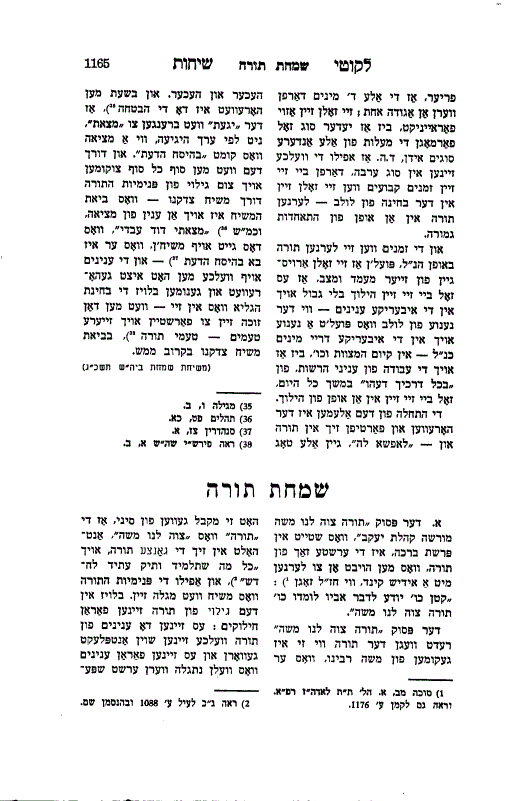
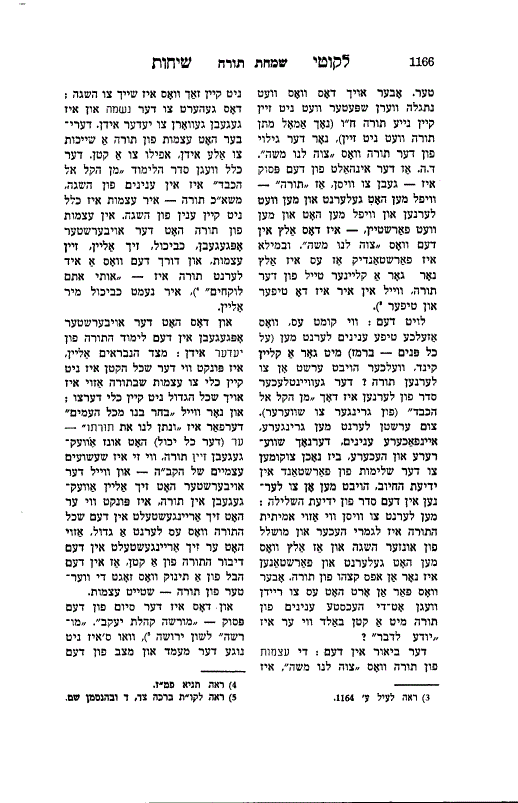
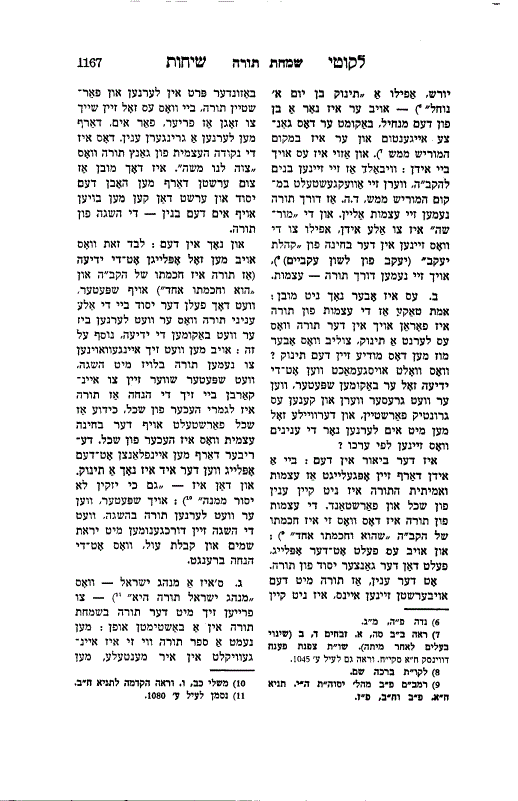
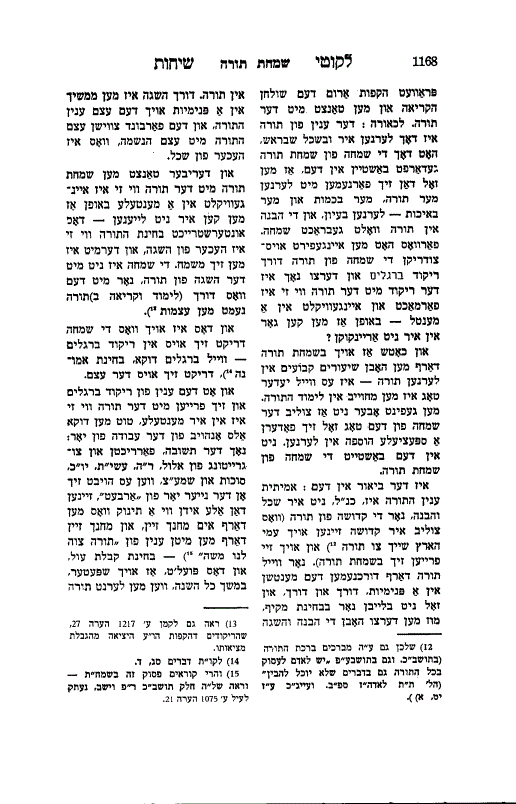
Likkutei Sichos Vol. 4 – Simchas Torah – Children and "Torah Tzivah Lanu Moshe"
1. The Rebbe explains that all four species used on Sukkos must be united into one entity, so that each type possesses the qualities of all the others. This means that even those who are in the category of the willow must have set times when they are in the state of the lulav — engaging in Torah study in a manner of complete unity.
And during the times when they learn Torah in this manner, it influences them to transcend their current state and status, so that they experience an unlimited progression in all other matters as well. This is similar to the movement of the lulav, which affects the movement of the other three species, as mentioned earlier — in the fulfillment of mitzvos, etc., and even in matters of permissible activities, as in "In all your ways, know Him" throughout the entire day, in a manner of continuous progression.
The beginning of this for everyone is the toil and immersion in Torah, as it is said, "toiling in it every day."
2. And while one toils, there is the promise that "if you toil, you will find," which is given according to the measure of the toil, like a discovery that comes unexpectedly. Through this, one will ultimately also reach the revelation of the inner dimension of the Torah through our righteous Mashiach — whose coming is also a matter of discovery, as it is stated, "I have found David My servant," which refers to Mashiach, who will come unexpectedly. And the matters on which one has toiled and only grasped their revealed aspect — one will then merit to understand their reasons — the reasons of the Torah — with the coming of our righteous Mashiach, very soon indeed.
3. However, even that which will not be a new Torah, G‑d forbid, is related to comprehension. It will be revealed later and will not be a new Torah given to every Jew. Rather, it will be the revelation of the essence of the Torah, which is already given to all Jews, even to a child. The essence of the Torah, "which Moses commanded us," belongs to all Jews. The content of this verse is about the order of study — from the easier to the more difficult. The essence of the Torah is not a matter of comprehension. In its essence, it is not dependent on how much one has learned or will learn, nor on how much one has understood. It is always only a small part of the Torah because within it lies deeper and deeper levels.
The way it comes is that the L‑rd has given such deep matters to be learned (at least hinted at) even by a small child who is just beginning to learn Torah. The usual order of learning is from the easier to the more difficult. The simpler matters are learned first, and then the more complex ones. However, the essence of the Torah is not dependent on the intellect of the learner. Just as the small intellect is not a vessel for the essence of the Torah, so too is the great intellect not a vessel for it. It is only because "He chose us from all the nations" that He has given us His essence. And since He, the Omnipotent, has chosen us, He has given us His essence, and therefore, the essence of the Torah is accessible to every Jew.
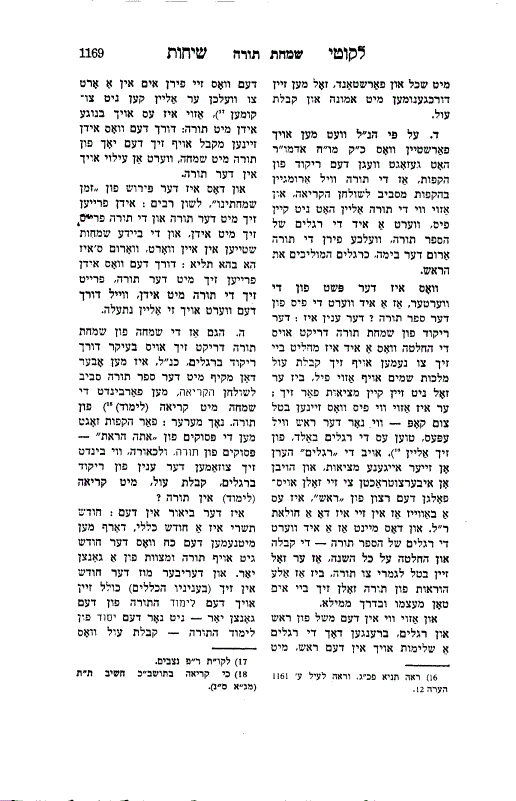
3. The celebration of Simchas Torah involves dancing around the reading table and dancing with the Torah. At first glance, the essence of Torah is to study it with the intellect in one's head. Therefore, the joy of Simchas Torah should seemingly consist of engaging in more Torah study, both quantitatively and qualitatively — learning with depth and understanding. This would bring joy. Why then was it established to express the joy of Torah through dancing with one's feet, and furthermore, the dance is with the Torah as it is closed and wrapped in a mantle, in a manner where one cannot even look inside it?
And although on Simchas Torah one must also have fixed times for Torah study — this is because every day one is obligated in the study of Torah. However, we do not find that due to the joy of the day there is a requirement for a special increase in learning. The joy of Simchas Torah does not consist in this.
4. The Torah is not accessed through intellect alone. Through comprehension, one does not draw down the inner essence of the Torah. The connection between the essence of the Torah and the essence of the soul is beyond intellect. Therefore, we celebrate Simchas Torah with the Torah as it is wrapped in a mantle, in a manner where one cannot read from it. This underscores the aspect of the Torah that is beyond comprehension, and it is with this that we rejoice. The joy is not with the comprehension of Torah, but with that which transcends it. (Through study and reading of the Torah, one draws down the essence.)
This is also why the joy is expressed through dancing with one's feet — specifically with the feet. The essence is expressed in this manner. The act of dancing with the feet and rejoicing with the Torah as it is in its mantle is done specifically as the beginning of the service of the year, following the repentance and preparation of Elul, Rosh Hashanah, the Ten Days of Repentance, and Yom Kippur.
According to the above, we can also understand what the Rebbe, my father-in-law, said regarding the dancing of the hakafos: that the Torah wants to go around in the hakafos around the reading table. Although the Torah itself has no feet, the Jew becomes the feet of the Torah. The feet of the Sefer Torah carry the Torah around the bimah, just as the feet carry the head.
The essence of these words is that a Jew becomes the feet of the Sefer Torah. The concept of the dancing on Simchas Torah expresses the resolution that a Jew decides to accept upon himself the yoke of the Kingdom of Heaven to such an extent that he does not consider himself a separate entity. He is like the feet that are nullified to the head — whatever the head wants, the feet do without their own will. If the "feet" have their own existence and lift themselves, they lead him to a place he cannot reach on his own. This is also true regarding Jews and the Torah: through accepting upon themselves the yoke of the Torah with joy, there is an elevation in the Torah itself.
This is the explanation of "Zman Simchaseinu" — in plural: Jews rejoice with the Torah, and the Torah rejoices with the Jews. Both joys are contained in one word, for they are interdependent: through Jews rejoicing with the Torah, the Torah itself is elevated.
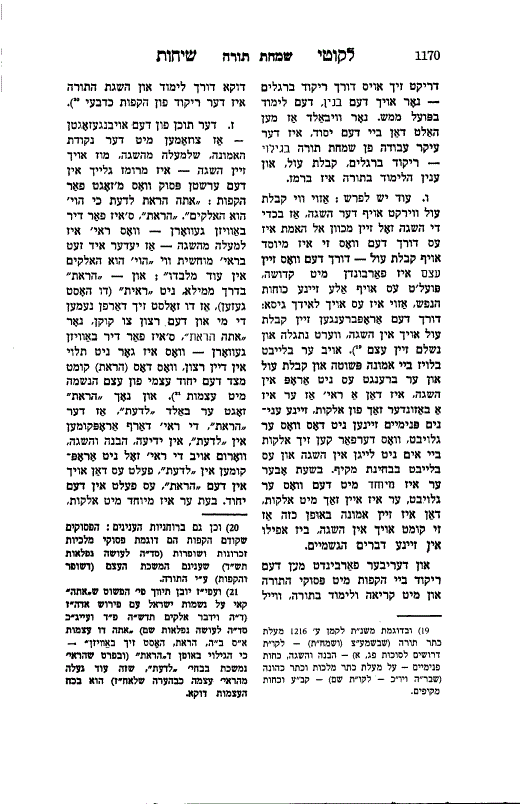
5. The expression of joy through dancing with the feet also includes the aspect of study in actual practice. Since we are dealing with the essence, the primary service of Simchas Torah is revealed through dancing with the feet. Acceptance of the yoke and the aspect of Torah study are elevated. Furthermore, it can be explained that this acceptance of the yoke influences one's understanding. In order for the understanding to be aligned with the truth, it must be based on acceptance of the yoke. Through this, the essence is drawn down with holiness, affecting all of one's soul powers. Conversely, by bringing one's acceptance of the yoke into understanding, one's essence is revealed and elevated. If one remains only with simple faith and acceptance of the yoke, without bringing it into understanding, it indicates a lack in one's connection to G‑dliness. When one's inner faculties are aligned with what one believes, G‑dliness can be integrated into one's understanding, rather than remaining in a state of makif (encompassing). However,
specifically through the study and comprehension of Torah, the dancing of the hakafos is complete. The content of the above explanation — that together with the strength of faith, which is beyond understanding, there must also be comprehension — is hinted at in the first verse recited before the hakafos: "You have been shown to know that the L‑rd is G‑d." "You have been shown" indicates that it has become evident to you — a level of seeing that is beyond understanding — that every Jew sees with tangible vision that "the L‑rd is G‑d; there is none else besides Him." The phrase "You have been shown" implies that it is not "you have seen" (which would require effort and will to look), but rather "You have been shown," indicating that it has been revealed to you without dependence on your will. This revelation comes from the essential unity of the essence of the soul with the Essence of G‑d. After "You have been shown," it says immediately "to know," indicating that this revelation must descend into "to know," into knowledge, understanding, and comprehension. For if the vision does not descend into "to know," it is still lacking.
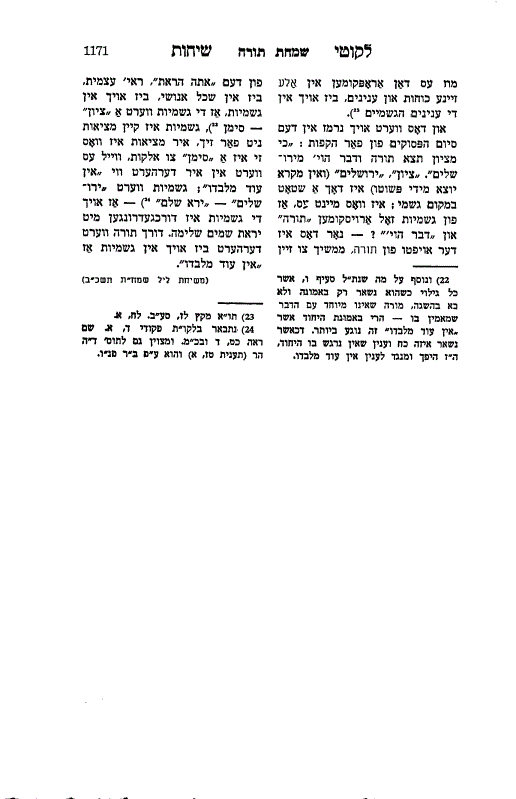
The descent of the vision into "to know" must occur within one's faculties and matters, both in the intellectual and emotional realms, and even in the physical. This is also hinted at in the verse "For from Zion shall go forth the Torah, and the word of the L‑rd from Jerusalem." The revelation of G‑dliness must be heard and perceived in the physical world, transforming it into a place of holiness. This means that the fear of G‑d should emerge from the physical into the spiritual, leading to a complete fear of Heaven. This is the purpose of the hakafos, to reveal that "there is none else besides Him."
Everything mentioned above in section 5, which is the practical application of the concepts, is made possible through the study and comprehension of Torah, as it is explained in the teachings of Chassidus. The verse "You have been shown to know" is a call to action, to bring the revelation into one's life and to transform one's surroundings into a dwelling place for G‑dliness. This is the ultimate purpose of Simchas Torah, to unite the joy of the Torah with the joy of the Jew, creating a complete and harmonious celebration of G‑d's presence in the world.