What question is the Rebbe addressing in this Sicha?
What is the answer of the ירושלמי?
What is the answer of the מדרש?
What is the answer in the קבלה?
What is the question on the first answer?
What is the question on the second answer?
What is the question on the third answer?
The fact that all the זקנים translated as if it was written אלקים ברא בראשית proofs not like any of the answers but?
In addition, it is also surprising?
How do חז"ל explain the פסוק that states על מה אבדה הארץ על עזבם את תורתי?
How do the ב"ח and רבינו יונה explain this?
How do they explain the meaning of אבדה הארץ?
What are the 2 levels in the study of Torah?
With witch level must one start with and how do we know this?
How does the Rebbe explain with this why the Torah begins with a ב?
Parshas Bereishis
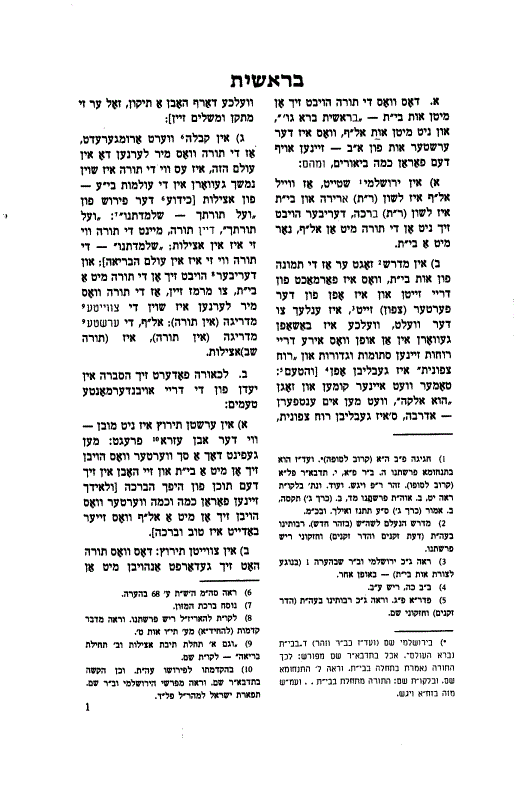
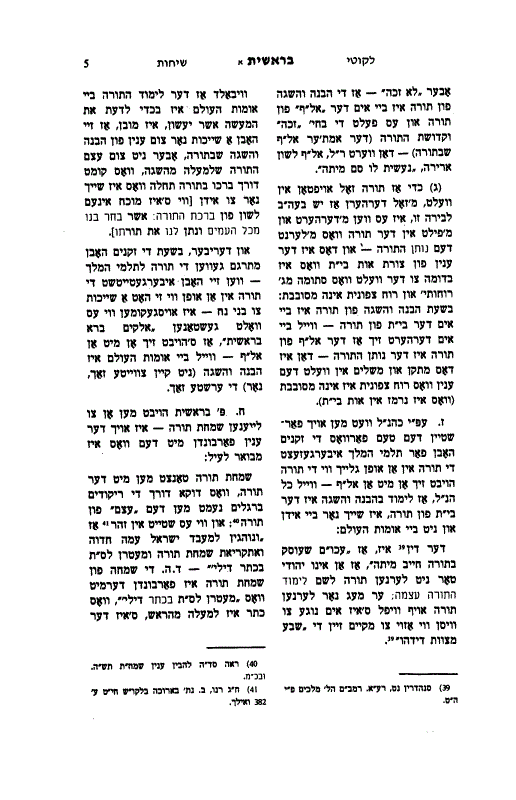
1. The fact that the Torah begins with the letter beis — "Bereishis bara etc." — and not with the letter alef, which is the first letter of the alef-beis — on this there are a number of explanations, among them:
a) In the Yerushalmi[1] it states that since alef is an expression of (the initial letter of) arirah, curse, and beis is an expression of (the initial letter of) berachah, blessing, therefore the Torah does not begin with an alef, but with a beis.
b) In the Midrash[2] it says that the form of the letter beis, which is closed on three sides and open on the fourth (northern) side[3], resembles the world, which was created in such a manner that three of its directions are sealed and enclosed while the "northern direction" was left open[4] [and the reason[5]: should someone come and say "he is a god," he will be answered — on the contrary, the northern direction was left open, which requires a rectification; let him rectify and complete it]:
c) In Kabbalah[6] it is discussed that the Torah which we study here in this world is Torah as it has already been drawn down into the worlds of Beri'ah, Yetzirah and Asiyah from Atzilus [as is known[7], the interpretation of "and for Your Torah which You have taught me"[8]: "and for Your Torah," Your Torah, means the Torah as it is in Atzilus; "which You have taught me," the Torah as it is in the world of Beri'ah]; and therefore[9] the Torah begins with a beis, to allude that the Torah which we study is already the second[9] level (in Torah): alef, the first[9] level (in Torah), is (the Torah of) Atzilus.
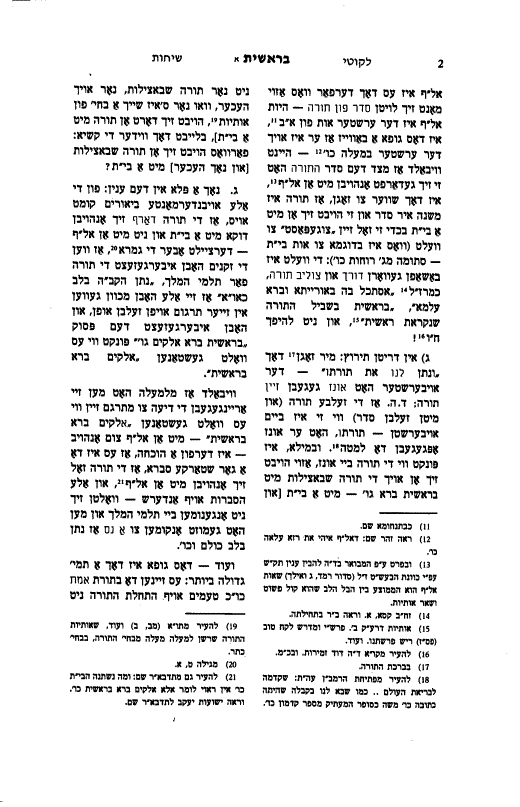
2. Each of the three reasons mentioned above would seem to require explanation:
a) In the first answer it is not understood — as the Ibn Ezra[10] asks: we find many words that begin with a beis and that contain within them the content of the opposite of blessing [and conversely there are numerous words that begin with an alef whose meaning is good and blessing].
b) In the second answer: the reason the Torah should have begun with an alef is because that is what the order of the Torah demands — since alef is the first letter of the alef-beis[11], that itself is a proof that it is also the first in importance, etc.[12] — now, since by virtue of the order of the Torah it should have begun with an alef[13], it is difficult to say that the Torah changes its order and begins with a beis so that it should be "fitted" to the world (which resembles the letter beis — sealed on three sides, etc.): the world was created through Torah and for the sake of Torah, as our Sages say[14], "He looked into the Torah and created the world," "Bereishis — for the sake of the Torah, which is called reishis"[15], and not the reverse, G‑d forbid[16]!
c) In the third answer: [— text missing in the Hebrew source at this point; footnotes 17 and 18 are likewise absent —] not only Torah of Atzilus, but even higher, wherever an aspect of letters is at all applicable, Torah there begins with a beis] — the question nevertheless remains: why does the Torah of Atzilus [and higher still] begin with a beis?
3. There is a further difficulty in this matter: from all the explanations mentioned above it emerges that the Torah must begin specifically with a beis and not with an alef — yet the Gemara relates[20] that when the Elders translated the Torah for King Ptolemy, "the Holy One, blessed be He, placed in the heart of each one" that they all intended the same rendering in their translation, and they translated the verse "Bereishis bara Elokim etc." exactly as though it read "Elokim bara bereishis."
Since from Above they were given the understanding to translate as though it read "Elokim bara bereishis" — with an alef at the beginning — this is a proof that there is a very strong reasoning that the Torah should begin with an alef[21], and all the explanations to the contrary would not have been accepted by King Ptolemy, and it was necessary to resort to a miracle, that it was placed in the heart of all of them, etc.
Moreover — this itself is an exceedingly great wonder: there are in the Torah of truth a number of reasons for the Torah's not beginning with an alef, and not one of them could be accepted by King Ptolemy?!
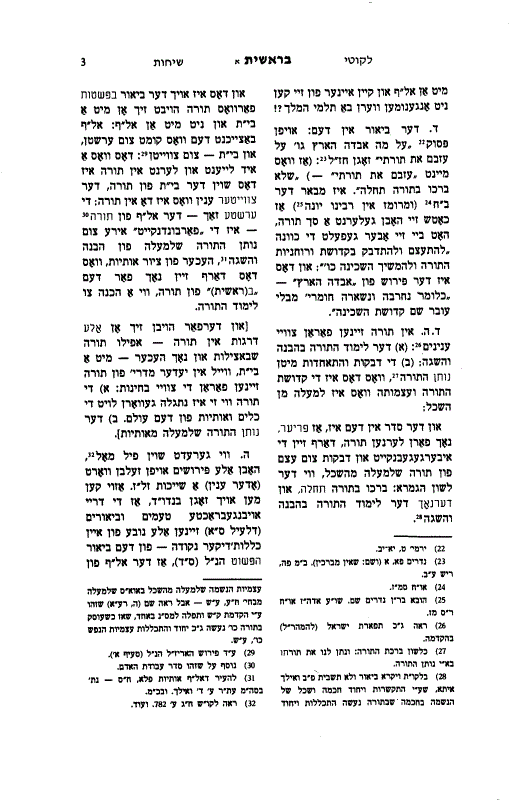
4. The explanation of this: on the verse[22] "For what reason was the land lost... because they forsook My Torah," our Sages say[23] (that what "they forsook My Torah" means is —) "that they did not recite the blessing over the Torah first." The Bach[24] explains (and it is alluded to in Rabbeinu Yonah[25]) that although they studied a great deal of Torah, what was lacking in them was the intent "to bond with and cleave to the holiness and spirituality of the Torah and to draw down the Shechinah, etc."; and this is the meaning of "the land was lost" — "that is to say, it was destroyed and remained material, without the holiness of the Shechinah passing there."
That is to say, there are two matters in Torah[26]: (a) the study of Torah with understanding and comprehension; (b) the cleaving and union with the Giver of the Torah[27], which is the holiness of the Torah and its essence, which is above intellect:
And the order in this is that first, before studying Torah, there must be the devotion and cleaving to the essence of Torah which is above intellect, as the language of the Gemara has it: they recited the blessing over the Torah first — and afterwards the study of Torah with understanding and comprehension[28].
And this is also the simple explanation of why the Torah begins with a beis and not with an alef: alef denotes that which comes first, and beis — that which comes second[29]: what a Jew reads and studies in Torah is already the beis of Torah, the second matter that is present in Torah; the first thing — the alef of Torah[30] — is its "bond" with the Giver of the Torah, which is above understanding and comprehension[31], higher than the form of letters, and this must come before the "b(ereishis)" of Torah, as a preparation for the study of Torah.
(And this is why all the levels in Torah — even the Torah of Atzilus and higher still — begin with a beis, because in every level of Torah these two aspects are present: a) the Torah as it has been revealed according to the vessels and letters of that world; b) the Giver of the Torah, who is above letters.)
5. As has been discussed many times[32], all the interpretations of the same word (or matter) bear a relationship to one another. So too one may say in our case, that the three reasons and explanations brought above (in section 1) all flow from one general point — from the simple explanation stated above (section 4), that the alef of Torah is the cleaving and bonding with the level that is higher than comprehension, and the study of Torah with understanding and comprehension is the beis of Torah; and this general point and explanation expresses itself in three particular matters in Torah and its effect (which are alluded to in the three explanations mentioned above):
(a) With regard to Torah itself — the interpretation of Kabbalah, that the alef of Torah is the Torah of Atzilus, and the beis — the Torah of Beri'ah;
(b) The effect upon the person who studies Torah — through his sensing that the understanding and comprehension in Torah is merely the beis of Torah, his study is in a manner of (beis, an expression of) blessing, and not, G‑d forbid, in a manner of (alef, which is then an expression of) curse.
(c) The effect of Torah upon creation — when the study of Torah is as it ought to be, that the alef of Torah is present first, one rectifies the northern direction which is not enclosed (which is alluded to in the letter beis).
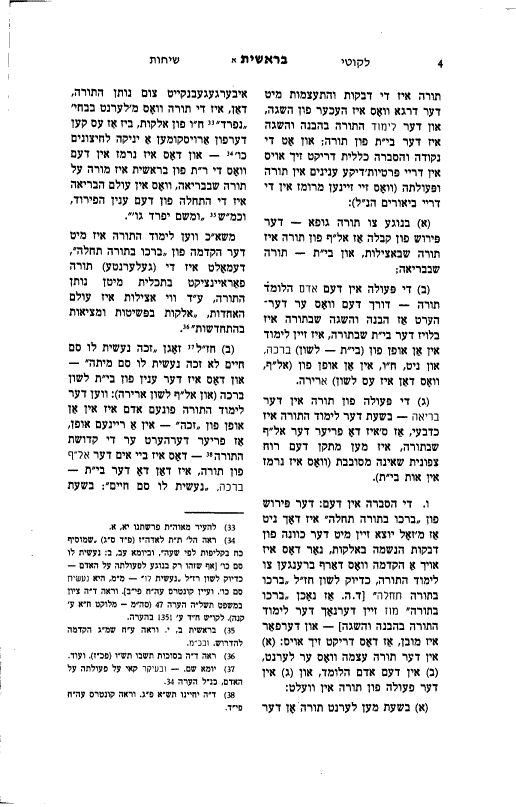
6. The explanation of this: the meaning of "they recited the blessing over the Torah first" is surely not that one should discharge his duty with the intent of the soul's cleaving to G‑dliness alone; rather, this too is an introduction which must lead to the study of Torah, as is precise in the language of our Sages, "they recited the blessing over the Torah first" [that is, that after "reciting the blessing over the Torah" there must follow the study of Torah with understanding and comprehension] — and therefore it is understood that this expresses itself: (a) in the Torah itself which he studies, (b) in the person who studies, and (c) in the effect of Torah in the world:
(a) When one studies Torah without the devotion to the Giver of the Torah, then the Torah one studies is in an aspect of "separateness"[33], G‑d forbid, from G‑dliness, to the point that there can result from it a nurture for the chitzonim, etc.[34] — and this is alluded to in the fact that the initial letters of bereishis indicate the Torah of Beri'ah, for in the world of Beri'ah is the beginning of the matter of separation, as it is written[35], "and from there it separated, etc."
This is not so when the study of Torah is with the introduction of "they recited the blessing over the Torah first"; then the (studied) Torah is united in the ultimate manner with the Giver of the Torah, similar to the way Atzilus is the world of unity, "G‑dliness in simplicity and existence in innovation"[36].
(b) Our Sages say[37], "If he is meritorious it becomes for him an elixir of life; if he is not meritorious it becomes for him a potion of death" — and this is the matter of beis as an expression of blessing (and alef as an expression of curse): when a person's study of Torah is in a manner of "meritorious" — in a pure manner, that first he senses the holiness of the Torah[38] — that is for him the alef of Torah, and then the beis is present — blessing, "it becomes for him an elixir of life": but when "he is not meritorious" — when the understanding and comprehension of Torah is for him the "alef" of Torah and the aspect of "meritorious" and the holiness of the Torah (the true alef of Torah) is lacking — then it becomes, G‑d spare us, alef as an expression of curse, "it becomes for him a potion of death."
(c) In order that Torah should accomplish in the world that one sense that there is an Owner to this palace, this comes about when one senses and feels the Giver of the Torah in the Torah that one studies — and this is the matter of the form of the letter beis, which resembles the world that is sealed on three of its sides while the northern direction is not enclosed: when the understanding and comprehension of Torah is for him the beis of Torah — because he senses that the alef of Torah is the Giver of the Torah — then this rectifies and completes in the world the matter of the northern direction being unenclosed (which is alluded to in the letter beis).
7. In light of all the above, one will also understand the reason why the Elders translated the Torah for King Ptolemy in a manner as though the Torah begins with an alef — because all of the above, that study with understanding and comprehension is the beis of Torah, applies only to Jews and not to the nations of the world:
The law[39] is that "a gentile who occupies himself with Torah is liable to death," that a non-Jew may not study Torah for the sake of the study of Torah itself; he may study Torah only to the extent that it is relevant to him to know how to fulfill their "seven mitzvos"[39].
Since the study of Torah among the nations of the world is only in order to know the deed which they must do, it is understood that they have a relationship only to the matter of understanding and comprehension in Torah, but not to the essence of Torah which is above comprehension, which comes through reciting the blessing over the Torah first, which pertains only to Jews [as is evident from the wording of the blessing over the Torah: "who has chosen us from all the nations and given us His Torah"].
And therefore, when the Elders translated the Torah for King Ptolemy — when they rendered the Torah in a manner in which it bears a relationship to the Noahides — it came out as though it read "Elokim bara bereishis," that it begins with an alef — because among the nations of the world understanding and comprehension is (not a second thing, but) the first thing.
8. Parshas Bereishis is begun to be read on Simchas Torah — this matter too is connected with what was explained above:
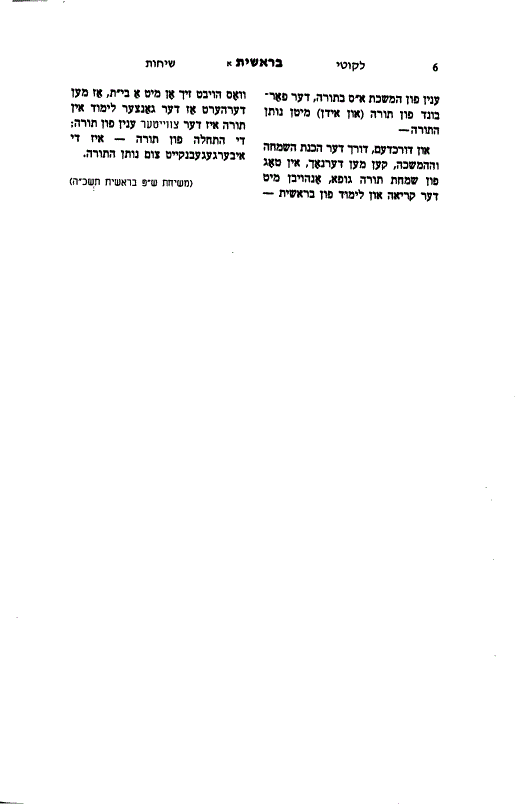
On Simchas Torah one dances with the Torah, for specifically through the dancing with the feet one takes hold of the "essence" of Torah[40]; and as it is stated in the Zohar[41] that "Israel are accustomed to make a rejoicing with it, and it is called Simchas Torah, and they crown the Torah scroll with its crown" — that is, the joy of Simchas Torah is bound up with the fact that "they crown the Torah scroll with its crown," for kesser is above the head; it is the matter of the drawing down of the Infinite into Torah, the bond of Torah (and of Jews) with the Giver of the Torah —
And through this, through the preparation of the joy and the drawing down, one can afterwards, on the day of Simchas Torah itself, begin with the reading and study of Bereishis —
Which begins with a beis, that one senses that the entire study of Torah is the second matter of Torah; the beginning of Torah — is the devotion to the Giver of the Torah.
(From a talk of Shabbos Parshas Bereishis, 5725)
Key Lesson
The Torah opens with a beis because what we read and comprehend is only the second thing in Torah; the first is the bond with the Giver of the Torah, which stands above intellect and above letters altogether. That is why the blessing over the Torah must come before the study — without it, learning is severed from its Source, and with it, the same learning becomes an elixir of life and reveals the Owner of the palace to the world. Simchas Torah, when we dance with the closed scroll and crown it, is precisely that alef, and only afterward do we begin to read "Bereishis."